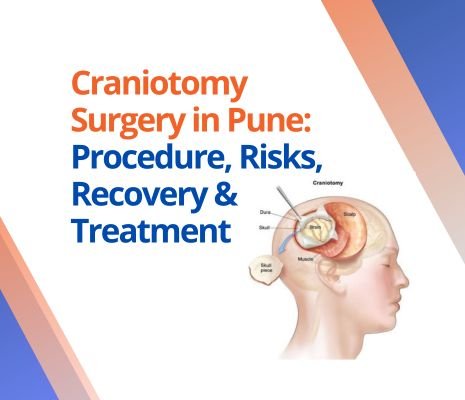
A craniotomy is a type of brain surgery in which a neurosurgeon temporarily removes a small portion of the skull to access and treat the brain. Once the required procedure is completed, the bone flap is usually placed back and secured.
Craniotomy surgery may be required for conditions such as brain tumors, brain aneurysms, blood clots, arteriovenous malformations (AVMs), head injuries, epilepsy and certain neurological emergencies.
If you or a family member has been advised to undergo craniotomy surgery in Pune, understanding why the procedure is recommended, how it is performed and what recovery involves can help you make a more informed decision.
What Is Craniotomy Surgery?
During a craniotomy, a neurosurgeon creates an opening in the skull by temporarily removing a section of bone known as a bone flap. This provides access to the affected part of the brain.
Depending on the condition, the surgeon may then:
- Remove a brain tumor
- Repair or clip a brain aneurysm
- Remove a blood clot or hematoma
- Treat abnormal blood vessels such as an AVM
- Control bleeding inside the brain
- Treat certain types of epilepsy
- Repair damage caused by traumatic brain injury
- Reduce pressure affecting the brain
After treatment, the bone flap is generally returned to its original position and secured.
When Is a Craniotomy Needed?
A neurosurgeon may recommend craniotomy when a condition cannot be treated adequately using medicines or less invasive procedures.
1. Brain Tumor Surgery
Craniotomy is commonly performed to remove or obtain a biopsy of a brain tumor.
The goal may be to remove as much of the tumor as safely possible while protecting important areas responsible for movement, speech, vision and other neurological functions.
2. Brain Aneurysm
Some brain aneurysms may require surgery to prevent or control bleeding.
During surgical clipping, the neurosurgeon accesses the aneurysm through a craniotomy and places a small clip at its base to stop blood from entering it.
Whether clipping or an endovascular treatment such as coiling is more appropriate depends on the aneurysm’s location, size, shape and the patient’s overall condition.
3. Blood Clot or Brain Hemorrhage
Bleeding following a severe head injury or rupture of a blood vessel may produce a collection of blood inside the skull.
If the clot is placing dangerous pressure on the brain, surgery may be required to remove it.
4. Arteriovenous Malformation (AVM)
An AVM is an abnormal connection between arteries and veins in the brain. In selected cases, craniotomy may be used to surgically remove the abnormal blood vessels.
5. Epilepsy
In carefully selected patients whose seizures continue despite appropriate medication, brain surgery may be considered when doctors can identify a specific area responsible for the seizures.
6. Severe Head Injury
Craniotomy or another type of emergency brain surgery may be required after a serious head injury when there is bleeding, a skull fracture or another condition requiring access to the brain.
How Is Craniotomy Surgery Performed?
The exact procedure varies according to the condition being treated and its location within the brain.
Before surgery, investigations may include:
- MRI brain
- CT scan
- CT angiography or cerebral angiography when required
- Blood investigations
- Neurological examination
- Other specialised imaging or functional testing
Modern neurosurgery may also use computer-assisted navigation and MRI or CT imaging to help surgeons accurately locate abnormalities within the brain.
During Surgery
The patient is positioned so the surgeon can safely access the required part of the brain.
A section of the scalp is opened and small openings are created in the skull. A carefully planned bone flap is then temporarily removed.
The neurosurgeon performs the required treatment using specialised microsurgical instruments and, where appropriate, surgical microscopes, neuronavigation or endoscopic techniques.
After the procedure, the bone flap is usually replaced and secured before the scalp is closed.
What Is an Awake Craniotomy?
Despite the name, an awake craniotomy does not necessarily mean the patient remains fully awake throughout the entire operation.
During certain stages, the patient may be awake enough to speak, move or perform specific tasks while the neurosurgical team monitors important brain functions.
Awake craniotomy may be considered when a tumor or abnormality lies close to areas controlling functions such as:
- Speech
- Language
- Movement
- Vision
This allows the neurosurgical team to monitor these functions during surgery and may help protect critical areas of the brain.
Types of Craniotomy
The surgical approach depends mainly on where the abnormality is located.
Common approaches include:
Frontal craniotomy: Accesses the front portion of the brain.
Temporal craniotomy: Provides access through the side of the skull.
Frontotemporal or pterional craniotomy: Frequently used to approach certain aneurysms and tumors.
Suboccipital craniotomy: Used for conditions involving structures toward the back or base of the brain.
Retrosigmoid or keyhole craniotomy: A smaller opening behind the ear that may be used for selected skull-base and posterior-fossa conditions.
The appropriate technique is selected after reviewing brain scans and the individual patient’s condition.
Craniotomy vs Craniectomy: What Is the Difference?
Patients often confuse these two terms.
In a craniotomy, part of the skull is temporarily removed and normally replaced during the same surgery.
In a craniectomy, part of the skull is removed but is not immediately replaced, often because the brain needs additional space due to severe swelling or pressure. The skull may be reconstructed later through a procedure called cranioplasty.
Is Craniotomy a Major Surgery?
Yes. A craniotomy is considered major brain surgery.
However, the complexity and risk can vary considerably depending on:
- Reason for surgery
- Location of the abnormality
- Size and type of lesion
- Patient’s age
- Overall health
- Whether important brain structures are involved
- Whether surgery is planned or performed as an emergency
This is why treatment needs to be individually planned by an experienced neurosurgical team.
Risks of Craniotomy Surgery
Every brain surgery has potential risks, although the specific risk varies according to the area being operated on and the underlying condition.
Possible complications can include:
- Bleeding
- Infection
- Brain swelling
- Seizures
- Blood clots
- Cerebrospinal fluid leakage
- Weakness or difficulty moving
- Speech or language difficulties
- Balance or coordination problems
- Changes in neurological function
- Risks related to anaesthesia
Certain complications are uncommon but can be serious. Your neurosurgeon should discuss the individual benefits and risks before surgery.
What Happens After Craniotomy Surgery?
After surgery, patients are usually monitored closely in an ICU or specialised neurosurgical unit.
Doctors and nurses regularly assess:
- Consciousness and alertness
- Arm and leg movement
- Speech
- Vision and pupil responses
- Blood pressure
- Breathing
- Neurological function
Follow-up CT or MRI scans may be required depending on the condition and procedure.
Some patients may also require physiotherapy, speech therapy or neurological rehabilitation during recovery.
Craniotomy Surgery Recovery Time
Recovery varies significantly from one patient to another.
Cleveland Clinic notes an average recovery period of approximately six to eight weeks, although recovery can be shorter or substantially longer depending on why surgery was performed and the patient’s neurological condition.
During recovery, patients may initially experience:
- Tiredness
- Mild headaches
- Scalp discomfort
- Temporary swelling
- Reduced stamina
Activity is usually increased gradually according to the neurosurgeon’s advice.
Patients should avoid heavy physical activity and should not resume driving until cleared by their treating doctor.
Warning Signs After Brain Surgery
Contact your treating medical team promptly if you develop unusual symptoms following surgery.
Urgent medical attention may be required for symptoms such as:
- New weakness of the arm or leg
- Difficulty speaking
- Increasing confusion or unusual drowsiness
- Seizure
- Severe or worsening headache
- Persistent vomiting
- Vision changes
- Fever
- Redness, swelling or discharge from the surgical wound
- Difficulty breathing
Post-operative instructions provided by your neurosurgical team should always take priority over general online information.
How to Choose a Neurosurgeon for Craniotomy Surgery in Pune
When considering brain surgery in Pune, patients and families should discuss more than simply whether surgery can be performed.
Ask the neurosurgeon:
- Why is craniotomy recommended?
- Are there non-surgical or minimally invasive alternatives?
- What is the exact goal of surgery?
- Which part of the brain will be operated on?
- What neurological functions are located near the surgical area?
- Is neuronavigation or intraoperative monitoring required?
- Is awake craniotomy appropriate?
- What are the individual risks?
- How long will hospitalisation and recovery take?
- Will rehabilitation be required after surgery?
For complex brain surgery, obtaining a second opinion from a neurosurgeon in Pune can also help patients better understand their diagnosis and available treatment options.
Cost of Craniotomy Surgery in Pune
There is no single fixed cost for craniotomy surgery.
The overall expense depends on factors such as:
- Diagnosis
- Complexity of surgery
- Emergency versus planned procedure
- ICU requirement
- Hospital stay
- Surgical technology required
- Imaging and investigations
- Implant or fixation requirements
- Rehabilitation
- Patient’s overall medical condition
A proper cost estimate can therefore usually be given only after the neurosurgeon has reviewed the patient’s MRI, CT scans and medical records.
Frequently Asked Questions About Craniotomy Surgery
Is craniotomy the same as brain surgery?
Craniotomy is one type of brain surgery. It specifically refers to creating an opening in the skull so the neurosurgeon can access the brain.
Is the skull replaced after craniotomy?
In most craniotomy procedures, the bone flap is replaced and secured at the end of surgery. If the bone is intentionally left out because of severe swelling, the procedure is generally considered a craniectomy rather than a standard craniotomy.
How long does craniotomy surgery take?
The duration varies widely depending on the condition and complexity. Some procedures may take several hours, while complex tumor or vascular surgery can take considerably longer.
How long will I stay in hospital after a craniotomy?
Hospital stay depends on the type of surgery and recovery. Some patients may remain in hospital for several days, while complicated cases may require a longer ICU stay or rehabilitation.
Can a patient live a normal life after craniotomy?
Many patients can return to their normal activities following successful recovery, but the outcome depends strongly on the underlying disease, the brain area involved and the patient’s neurological condition before and after surgery.
When should I consult a neurosurgeon in Pune?
Consult a neurosurgeon if brain imaging shows a tumor, aneurysm, AVM, intracranial bleeding or another abnormality that may require surgery. Urgent neurological symptoms such as sudden weakness, seizures, loss of consciousness or severe sudden headache require immediate emergency evaluation.
Looking for Craniotomy Surgery in Pune?
Being advised to undergo brain surgery can naturally lead to many questions. The decision to perform a craniotomy should be based on a detailed neurological examination, review of MRI or CT scans and a clear discussion about the expected benefits, risks and alternatives.
If you have been diagnosed with a brain tumor, brain aneurysm, AVM, brain hemorrhage or another condition requiring neurosurgical treatment, consult an experienced neurosurgeon in Pune for evaluation and an individualised treatment plan.