Neck pain that moves towards the shoulder, arm or hand can happen because of a damaged or slipped disc in the neck. Sometimes, the damaged disc presses on a nearby nerve or the spinal cord. This may cause pain, numbness, weakness, poor balance or difficulty using the hands.
Most neck disc problems are first treated with medicines, physiotherapy, rest and changes in daily activities. Surgery may be advised when these treatments do not provide relief, weakness increases or there is pressure on the spinal cord.
Two common surgeries for cervical disc problems are:
- Artificial Disc Replacement
- Cervical Fusion or ACDF
Both surgeries remove pressure from the nerve or spinal cord. The main difference is how the operated part of the neck works after surgery.
What Is Artificial Disc Replacement?
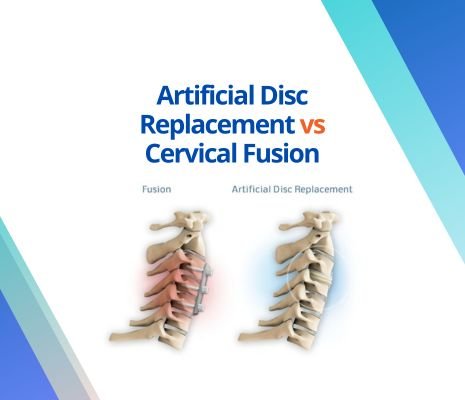
In Artificial Disc Replacement, the damaged disc in the neck is removed and replaced with an artificial disc.
The artificial disc helps to:
- Maintain movement in the operated area
- Restore the space between the neck bones
- Reduce pressure on the nerve or spinal cord
- Preserve natural neck movement
The two neck bones are not permanently joined. The operated part can continue to move, but every patient may not get complete movement back.
What Is Cervical Fusion?
Cervical fusion is also called Anterior Cervical Discectomy and Fusion, or ACDF.
During this surgery, the damaged disc is removed to reduce pressure on the nerve or spinal cord. A cage or bone graft is placed in the empty space. A plate and screws may also be used to keep the neck stable.
Over time, the two nearby bones join together and form one solid section. Movement at that particular level stops permanently.
Cervical fusion has been performed for many years. It is a trusted treatment for cervical disc problems, nerve compression and an unstable neck spine.
Artificial Disc Replacement vs Cervical Fusion
| Factor | Artificial Disc Replacement | Cervical Fusion |
|---|---|---|
| Movement | Tries to preserve movement | Stops movement at the operated level |
| Implant | Artificial movable disc | Cage or bone graft, sometimes with plate and screws |
| Bone joining | Bones do not need to join | Two neck bones must join together |
| Neck flexibility | Usually better preserved | Movement may reduce at the treated level |
| Suitable for | Carefully selected patients | A wider range of neck conditions |
| Nearby discs | May reduce pressure on nearby discs | Nearby discs may carry more pressure |
| Experience | Newer procedure | Used successfully for many years |
| Recovery | May allow earlier neck movement | Bone fusion needs time to develop |
Benefits of Artificial Disc Replacement
Maintains Neck Movement
The biggest advantage of artificial disc replacement is that it helps maintain movement at the treated level. It may be useful for younger or active patients who need good neck movement for their work and daily activities.
Bones Do Not Need to Join
Unlike cervical fusion, the success of disc replacement does not depend on two bones joining together. This removes the risk of delayed fusion or failure of the bones to join.
May Protect Nearby Discs
After cervical fusion, the discs above and below the operated level may have to handle more pressure. Artificial disc replacement allows more natural movement and may reduce stress on the nearby discs.
However, this does not mean that disc replacement is better for every patient.
May Allow an Earlier Return to Routine
As there is no need to wait for the bones to join, some patients may return to normal movement and routine activities earlier.
Recovery time can be different for every patient. It depends on the number of discs treated, the level of nerve pressure, type of work and overall health.
Risks of Artificial Disc Replacement
Artificial disc replacement is not suitable for every neck problem. Possible risks include:
- Movement of the implant from its correct position
- Wearing out of the artificial disc
- Extra bone formation around the implant
- Reduced movement over time
- Infection or bleeding
- Difficulty in swallowing
- Injury to a nerve or the spinal cord
- Neck or arm pain that continues or returns
- Need for another surgery
Choosing the right patient and correctly placing the artificial disc are very important for a successful result.
Benefits of Cervical Fusion
Trusted and Commonly Performed
ACDF is one of the most commonly performed neck spine surgeries. Doctors have been using this procedure for many years, and its results are well studied.
Provides Strong Stability
Fusion may be a better option when the neck spine is unstable or movement at the damaged level is causing pain.
Suitable for Severe Damage
Artificial disc replacement may not be suitable for patients with severe arthritis, large bone spurs, badly damaged joints, spinal deformity or major loss of disc height.
In such cases, cervical fusion can remove pressure and provide proper stability.
Can Treat Complicated Problems
Cervical fusion may be advised when:
- More than one neck level is damaged
- There is severe pressure on the spinal cord
- The neck has become unstable
- There is a spinal deformity
- The patient has undergone previous neck surgery
Risks of Cervical Fusion
Possible risks include:
- Bones may not join properly
- Reduced movement at the operated level
- Extra pressure on the nearby discs
- Problems with the plate, screws or cage
- Infection or bleeding
- Difficulty in swallowing
- Temporary voice changes
- Injury to a nerve or the spinal cord
- Neck or arm pain that continues
- Need for another surgery
Fusion at one level may cause only a small change in overall neck movement. The reduction may be more noticeable when multiple levels are fused.
Who May Be Suitable for Artificial Disc Replacement?
A patient may be considered for artificial disc replacement when they have:
- A slipped or damaged cervical disc
- Arm pain, numbness or weakness due to nerve pressure
- Pressure on the spinal cord at one or two suitable levels
- Symptoms that have not improved with medicines or physiotherapy
- Good bone strength
- Good movement at the affected level
- Healthy or only slightly damaged neck joints
- No major instability in the neck spine
The final decision depends on the patient’s age, symptoms, bone quality and MRI, X-ray or CT scan findings.
When May Cervical Fusion Be Better?
A spine surgeon may recommend cervical fusion when the patient has:
- An unstable neck spine
- Severe arthritis
- Advanced cervical spondylosis
- Very little movement at the damaged level
- Major loss of disc height
- Weak bones or osteoporosis
- Spinal deformity
- Infection, tumour or serious injury
- Previous neck surgery
- Problems at multiple levels
These conditions can make artificial disc replacement unsuitable or increase the risk of implant problems.
Which Surgery Is Better?
There is no single surgery that is better for every patient.
Artificial Disc Replacement may be better for a carefully selected patient who has one or two damaged discs, strong bones, healthy joints and a need to preserve neck movement.
Cervical Fusion may be better for a patient who has an unstable spine, severe arthritis, weak bones, advanced damage or a condition that needs stronger support.
Both surgeries can reduce arm pain, numbness and other symptoms caused by nerve pressure.
The decision should not be based only on which surgery is newer. It should be based on the patient’s condition, age, bone strength, spinal stability and scan findings.
Tests Needed Before Surgery
A spine surgeon may recommend:
- MRI of the cervical spine
- Cervical spine X-ray
- Bending X-rays to check movement and stability
- CT scan in selected cases
- Bone-density test if weak bones are suspected
- Nerve and muscle examination
- Evaluation of spinal joints and alignment
These tests help the surgeon decide whether neck movement should be preserved or whether the damaged level needs to be fused for stability.
Questions to Ask Your Spine Surgeon
Before choosing a surgery, you can ask:
- Which disc is causing my symptoms?
- Do I need surgery immediately?
- Can my problem improve without surgery?
- Am I suitable for artificial disc replacement?
- Are my bones and neck joints healthy?
- Is my neck spine unstable?
- How much neck movement will remain after surgery?
- What are the risks in my case?
- How much time will recovery take?
- Is there a chance that I may need another surgery?
Artificial Disc Replacement and Cervical Fusion in Pune
If you have long-lasting neck pain, arm pain, numbness, weakness, poor balance or difficulty using your hands, consult an experienced neurosurgeon or cervical spine surgeon in Pune.
The doctor will examine you and review your MRI and X-rays to understand whether surgery is required. If surgery is needed, the surgeon will decide whether Artificial Disc Replacement or Cervical Fusion is more suitable for you.
The aim is not simply to choose the latest treatment. The right surgery is the one that safely removes pressure from the nerves or spinal cord and provides the required movement and stability.
Medical disclaimer: This blog is meant only for general awareness. It should not replace medical advice, diagnosis or treatment from a qualified spine specialist.