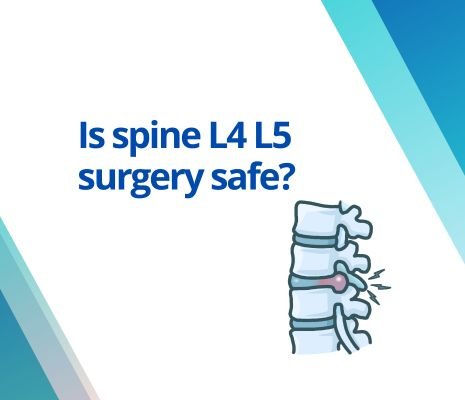
Back pain that travels down your leg, numbness in your feet, or difficulty walking can sometimes be caused by a problem at the L4-L5 level of the spine. When medicines and physiotherapy do not provide enough relief, your doctor may recommend surgery.
Naturally, one of the first questions patients ask is, “Is L4-L5 spine surgery safe?”
The answer is yes, L4-L5 spine surgery is generally considered safe and effective for appropriately selected patients, but no surgery is completely risk-free. Its safety depends on the patient’s overall health, the underlying spinal condition, the surgical technique, and the experience of the surgical team.
In this article, Dr. Vishal Bhasme, Neurosurgeon and Spine Specialist in Pune explains when L4-L5 surgery may be necessary, the risks involved, available surgical techniques, and what patients can expect during recovery.
What Is the L4-L5 Spine Problem?
The lower back, also called the lumbar spine, consists of five vertebrae, labelled L1 to L5. The L4-L5 level is located between the fourth and fifth lumbar vertebrae.
Between these bones is a soft, cushion-like disc that absorbs pressure and supports spinal movement.
Sometimes, this disc can bulge or herniate, pressing against nearby nerves. This may result in:
- Persistent lower back pain
- Pain radiating from the buttock to the leg, known as sciatica
- Tingling or numbness in the leg or foot
- Weakness in the leg or ankle
- Difficulty standing, sitting, or walking for long periods
However, not every L4-L5 disc bulge causes symptoms, and an abnormal MRI report does not automatically mean surgery is required.
To learn more about surgical treatment options, read Minimally Invasive Surgery for L4-L5 Disc Herniation in Pune.
When Is L4-L5 Spine Surgery Necessary?
Most patients with L4-L5 disc problems improve with non-surgical treatments, including appropriate medication, guided physiotherapy, exercise modifications, and sometimes spinal injections.
Surgery may be recommended when:
- Severe leg pain continues: Persistent sciatica does not improve with an adequate trial of conservative treatment.
- Muscle weakness develops or progresses: Nerve compression starts affecting leg or foot strength.
- Daily activities become difficult: Pain significantly interferes with walking, working, sleeping, or routine activities.
- MRI findings match the symptoms: Clinical examination and imaging show a surgically treatable cause of nerve compression.
- Emergency symptoms occur: New bladder or bowel dysfunction, numbness around the groin, or rapidly worsening leg weakness may indicate serious nerve compression requiring emergency assessment.
The decision to operate should be based on symptoms, neurological examination, MRI findings, and the expected benefits compared with the risks. AANS+1
How Safe Is L4-L5 Spine Surgery?
Modern L4-L5 procedures, including microdiscectomy and selected minimally invasive or endoscopic techniques, are established treatments for nerve compression.
For patients with a symptomatic herniated disc, surgery can provide meaningful relief from radiating leg pain, particularly when non-surgical treatment has not worked.
However, it is important to understand that surgery may not completely remove lower back pain, numbness can take longer to improve, and some patients may continue to experience symptoms.
Factors influencing safety include the severity of nerve compression, age, general medical condition, previous spine surgeries, and the type of procedure being performed.
Research supports surgery for appropriately selected patients with lumbar disc herniation, while emphasizing careful evaluation and shared decision-making. PubMed Central (PMC)+1
What Are the Risks of L4-L5 Spine Surgery?
Although serious complications are uncommon in many routine lumbar disc procedures, patients should understand the possible risks before undergoing surgery.
1. Infection: An infection may develop around the surgical wound or, less commonly, deeper in the spine.
2. Nerve injury: The nerves around the L4-L5 level are delicate. Injury could cause persistent numbness, pain, or weakness.
3. Dural tear: The protective covering around the spinal nerves may tear, potentially causing leakage of cerebrospinal fluid and sometimes requiring further treatment.
4. Recurrent disc herniation: A disc can herniate again after surgery, occasionally requiring additional treatment or another operation.
5. Persistent symptoms: Some patients may continue to experience pain or numbness despite successful removal of nerve compression.
6. Blood clots or anaesthesia-related complications: These are additional potential risks, with individual likelihood influenced by overall health and the complexity of surgery.
Serious complications such as major neurological injury are possible but uncommon. Your surgeon should explain the risks that apply specifically to your condition. NHS inform+1
Is Endoscopic L4-L5 Surgery Safer Than Open Spine Surgery?
Endoscopic spine surgery is a minimally invasive technique that uses a small camera and specialised instruments to access the affected area through a small incision.
For suitable patients, potential benefits can include less muscle disruption, reduced blood loss, smaller incisions, and a shorter hospital stay.
However, endoscopic surgery is not automatically safer or more effective for every patient. The choice between endoscopic surgery, microdiscectomy, open decompression, or another procedure depends on the location of the disc problem, spinal stability, and the surgeon’s assessment.
A 2024 international spine committee review noted potential short-term advantages of minimally invasive surgery but found insufficient evidence to recommend one discectomy technique over all others. PubMed Central (PMC)
Learn more about Endoscopic Spine Surgery in Pune: Procedure, Cost and Success Rate.
How Long Does It Take to Recover From L4-L5 Surgery?
Recovery depends on the procedure, the patient’s overall health, and the severity and duration of nerve compression.
After an uncomplicated lumbar discectomy or minimally invasive decompression, some patients can begin walking on the day of surgery or the following day.
Light daily activities may gradually resume over the following weeks, while physically demanding work, heavy lifting, and strenuous exercise generally require more time.
For patients undergoing spinal fusion, recovery can take considerably longer.
Your surgeon may recommend walking, gradual activity progression, physiotherapy, and temporary restrictions on bending, twisting, or lifting. Recovery instructions should always be individualised. guysandstthomas.nhs.uk+1
Can L4-L5 Disc Problems Be Treated Without Surgery?
Yes. Many patients with L4-L5 disc bulges or herniations recover without surgery.
Treatment may include physiotherapy, prescribed pain relief, staying gently active, and selected injections.
Surgery is usually considered when symptoms remain severe despite appropriate treatment or when neurological problems make early intervention necessary.
If your main complaint is pain radiating from your lower back into your leg, you can also read Sciatica Pain Treatment in Pune – Causes, Symptoms and Treatment Options.
Consult Dr. Vishal Bhasme for L4-L5 Spine Surgery in Pune
If you have been diagnosed with an L4-L5 disc bulge, slipped disc, or spinal nerve compression, understanding your treatment options is important before deciding on surgery.
Dr. Vishal Bhasme, Spine Surgeon in Pune provides evaluation and treatment for spine-related conditions, including lumbar disc herniation, sciatica, spinal stenosis, and other causes of nerve compression.
His clinical practice includes minimally invasive spine surgery, endoscopic spine surgery, and other neurosurgical procedures.
Patients can seek consultation at his associated locations in Pune, including Ruby Hall Clinic at Sangamvadi and Wanowrie and Lopmudra Hospitals, subject to appointment availability.
During consultation, Dr. Bhasme can assess your symptoms, examine your nerve function, review MRI findings, and discuss whether non-surgical treatment or a surgical procedure is appropriate.
For patients considering an operation, a second opinion before spine surgery can also help clarify the available treatment options.
For appointments: +91 8208378938
Website: www.drvishalbhasme.co.in
Frequently Asked Questions About L4-L5 Spine Surgery
1. Is L4-L5 spine surgery dangerous?
L4-L5 spine surgery is generally safe for appropriately selected patients, but complications can occur. The risk depends on the patient’s medical condition, surgical procedure, and complexity of the spinal problem.
2. Can I walk normally after L4-L5 surgery?
Many patients begin walking shortly after an uncomplicated lumbar discectomy. However, recovery depends on the procedure and the extent of nerve damage before surgery.
3. Can L4-L5 surgery cause paralysis?
Permanent paralysis is a rare but serious potential complication. Nerve injury can also cause weakness or numbness. Your surgeon can explain the procedure-specific risks.
4. Is L4-L5 surgery successful?
Many appropriately selected patients experience substantial improvement in leg pain after surgery. However, results vary, and complete relief from back pain or numbness cannot be guaranteed.
5. Which doctor should I consult for L4-L5 spine surgery in Pune?
A qualified neurosurgeon or orthopaedic spine surgeon can assess L4-L5 problems. Patients in Pune can consult Dr. Vishal Bhasme for an evaluation of disc-related nerve compression and available treatment options.
Conclusion
L4-L5 spine surgery can be a safe and effective treatment when performed for the right medical reasons. However, not every patient with an L4-L5 disc bulge requires surgery.
The most important step is determining whether symptoms are caused by nerve compression, whether non-surgical treatment is sufficient, and which procedure offers the most appropriate balance of benefits and risks.
If you are experiencing persistent lower back pain, sciatica, or leg weakness, consult a qualified spine specialist in Pune for an individual assessment. New bladder or bowel dysfunction, saddle numbness, or rapidly progressing weakness requires immediate emergency evaluation rather than a routine appointment.
Medical disclaimer: This article provides general health information and is not a substitute for individual medical advice. The draft should be medically reviewed by Dr. Vishal Bhasme before publication.