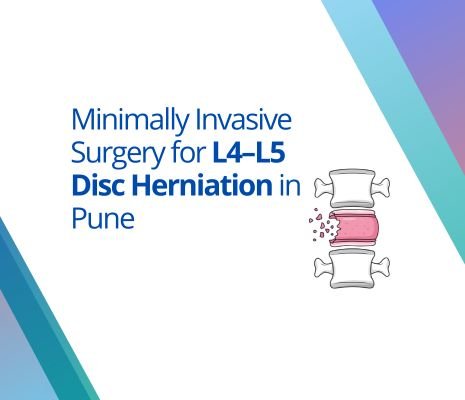
Lower back pain that travels down the leg is one of the most common reasons people visit a spine specialist. In many cases, this pain is caused by a disc herniation at the L4–L5 level, one of the most stress-bearing segments of the spine.
With advances in medical technology, minimally invasive and full endoscopic spine surgery have become highly effective options to treat this condition—often with faster recovery and less discomfort compared to traditional open surgery.
Understanding L4–L5 Disc Herniation
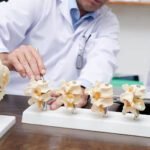
The spine is made up of bones (vertebrae) separated by soft cushions called intervertebral discs. These discs act as shock absorbers and help the spine move smoothly.
At the L4–L5 level (lower lumbar spine), a disc can slip or bulge out of place due to:
- Age-related wear and tear
- Poor posture or prolonged sitting
- Heavy lifting or sudden twisting
- Injury or trauma
When the disc presses on nearby nerves, it can cause:
- Lower back pain
- Pain radiating to the buttock, thigh, or leg (sciatica)
- Tingling, numbness, or weakness in the leg
- Difficulty standing or walking for long periods
When Is Surgery Considered?
Most patients improve with non-surgical treatments such as rest, medications, physiotherapy, and lifestyle changes.
Surgery may be advised when:
- Pain persists despite conservative treatment
- There is worsening leg pain or weakness
- Daily activities are severely affected
- Nerve compression is clearly seen on MRI
What Is Minimally Invasive Spine Surgery?
Minimally invasive spine surgery (MISS) uses small incisions and specialized instruments to treat the herniated disc while preserving surrounding muscles and tissues.
Key features:
- Small skin incision
- Minimal muscle damage
- Less blood loss
- Reduced post-operative pain
What Is Full Endoscopic Spine Surgery?
Full endoscopic spine surgery is an advanced form of minimally invasive surgery. It is performed using a thin camera (endoscope) that allows the surgeon to see the affected disc clearly on a screen.
The surgery is often done through a tiny incision (8–10 mm) and, in selected cases, even under local anesthesia.
Benefits of Minimally Invasive & Endoscopic Spine Surgery
Compared to traditional open spine surgery, patients often experience:
- Smaller scars
- Less muscle injury
- Reduced hospital stay (often same day or 1 day)
- Faster recovery and return to work
- Lower risk of infection
- Early pain relief
Recovery After Surgery
Most patients:
- Start walking within a few hours after surgery
- Are discharged the same day or next day
- Resume light activities within a few days
- Return to normal routine in a few weeks
Physiotherapy and posture correction play an important role in long-term recovery.
Is This Surgery Suitable for Everyone?
Not all disc herniations require surgery, and not all patients are ideal candidates for endoscopic procedures. A detailed hospital evaluation, imaging studies, and discussion with a spine specialist are essential to choose the right treatment.
A disc herniation at the L4–L5 level can significantly affect quality of life. Minimally invasive and full endoscopic spine surgery offer a safe, effective, and patient-friendly solution for selected cases, providing relief with minimal disruption to normal life.
If back or leg pain is limiting your daily activities, early consultation with a spine specialist in Pune can help determine the best course of treatment and prevent long-term nerve damage.