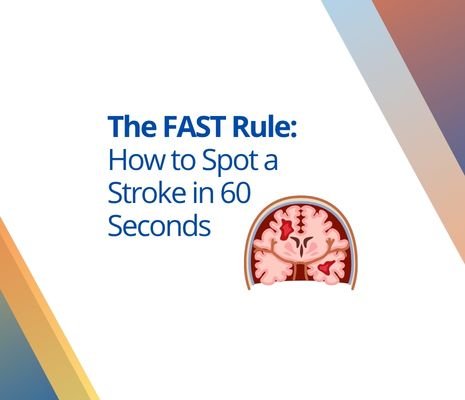
If you’ve ever heard the phrase “Time is Brain,” it’s not just a medical catchphrase—it’s a literal warning. During a stroke, your brain loses about 1.9 million neurons every single minute. That is nearly 2 million tiny “computer processors” that control how you speak, move, and remember, vanishing in the blink of an eye. The good news? You don’t need a medical degree to save a life. You just need to remember one word: F.A.S.T. – Brain Stroke Test.
What Exactly is a Brain Stroke?
Think of a stroke as a “brain attack.” Just like a heart attack happens when blood can’t reach the heart, a stroke happens when the blood supply to part of your brain is interrupted or reduced. This deprives brain tissue of oxygen and food. Within minutes, brain cells begin to die.
The 60-Second “FAST” Brain Stroke Test
If you suspect someone—a parent, a friend, or even a stranger—is acting strangely, run through this checklist immediately. It takes less than a minute.
F – Face Dropping
Ask the person to smile.
- What to look for: Does one side of the face droop or feel numb? Is the smile uneven or lopsided?
A – Arm Weakness
Ask the person to raise both arms out in front of them.
- What to look for: Does one arm drift downward? Is there a sudden clumsiness or inability to lift one side at all?
S – Speech Difficulty
Ask the person to repeat a simple phrase, like “The sky is blue.”
- What to look for: Is their speech slurred? Are they using the wrong words, or do they seem confused and unable to speak at all?
T – Time to Call Emergency Services
If the person fails even one of these tests, the “T” stands for Time.
- Action: Do not wait to see if they feel better. Do not give them aspirin. Call your local emergency number (like 102 or 108 in India) immediately.
Why “Time is Brain” Matters
When it comes to a stroke, there is a “Golden Window”—usually the first 3 to 4.5 hours.
- Reversing the Damage: Modern medicine has “clot-busting” drugs and advanced procedures (like mechanical thrombectomy) that can physically remove a blockage. However, these treatments only work if administered shortly after the symptoms start.
- Limiting Disability: The faster the blood flow is restored, the more likely a patient is to walk, talk, and return to their normal life.
- The “Wait and See” Trap: Many people think, “Maybe they’re just tired,” or “Let’s see how they feel after a nap.” In the world of neurosurgery, a nap during a stroke can be the difference between a full recovery and permanent paralysis.
A stroke is a medical emergency, but it is a treatable one—if you act fast. You are the first line of defense. By memorizing FAST, you aren’t just spotting symptoms; you are protecting someone’s ability to think, speak, and live.
Early diagnosis, advanced stroke management, and access to specialized care play a crucial role in recovery outcomes. Consulting an experienced neurosurgeon can help ensure accurate evaluation and appropriate treatment planning for brain-related emergencies and conditions.